CONTEXTUS
Resources
Professional Learning Tools
Practice Briefs
This is an example tasks that was specifically designed for use in teacher professional learning.
The beginnings of a practice brief and tool to support using student work in ways that build relationships.
The task scenario supports 3D sense-making and is accessible to a wide range of students.
The task prompts support 3D sense-making and are accessible to a wide range of students.
A primary goal of science education is transfer. The ability to use prior learning to creatively solve new problems is especially important in the face of so-called “wicked problems” —complex issues such as climate change that will require interdisciplinary teams of innovative thinkers to resolve. Science education today must equip students to use their learning to tackle broad, intractable problems such as those laid out in the Millennium Project. However, achieving transfer is difficult for a number of reasons. Even once students are successfully instructed in ways that promote transfer, assessing that knowledge can prove difficult.
The criteria in this document distinguish between criteria for grades as a product and criteria for grading as a process. Grades are the result of the grading process and in order to have an equitable system, both the process of grading and the grades that are the result of that process must change.
This brief describes three ways that federal executive action can help states realize their visions for more meaningful assessments. To view the full report visit https://learningpolicyinstitute.org/ product/developing-assessment-systems-federal-support.
This practice brief elevates the CCCs as a meaningful pathway to engage each and every student in science.
Presenting phenomena in a way that highlights a productive uncertainty for students to figure out.
Tasks
Student-centered systems requires that we consider those student how may feel left out of our vision.
Use Root Builders to build a connected community of learners and frame the learning and conversations to come.
High Leverage Professional Learning Strategies
Professional Learning Modules
This Toolkit is a sustained and supported professional learning experience designed to shift the culture of assessment to one that is more caring. The tools and processes presented here are the result of a pilot with educators from Colorado and Connecticut. The six modules are designed for flexible entry points and pathways to support district teams on a journey to develop more equitable 3D assessment systems with learners at the center.
This AMSTI Bite-Sized Module, Equity, is the third of four Foundations of Three Dimensional Science Assessment modules.
The extended modules expand on the foundational modules by diving deep into task quality. Evidence Centered Design is a 3 part module.
The extended modules expand on the foundational modules by diving deep into task quality.
This AMSTI Bite-Sized Module, Working Towards a System, is the last of four Systematizing and Implementing Three Dimensional Science Assessments modules.
This AMSTI Bite-Sized Module, Introduction to Systems of Assessment, is the third of four Systematizing and Implementing Three Dimensional Science Assessments modules.
This AMSTI Bite-Sized Module, Rubrics, is the second of four Systematizing and Implementing Three Dimensional Science Assessments modules.
This AMSTI Bite-Sized Module, Student Work Analysis, is the first of four Systematizing and Implementing Three Dimensional Science Assessments modules.
This AMSTI Bite-Sized Module, Assessment Purpose and Use, is the last of four Foundations of Three Dimensional Science Assessment modules.
This AMSTI Bite-Sized Module, The Three Dimensions, is the second of four Foundations of Three Dimensional Science Assessment modules.
This AMSTI Bite-Sized Module, Phenomena and Problem Solving, is the first of four Foundations of Three Dimensional Science Assessment modules.
This is an example tasks that was specifically designed for use in teacher professional learning.
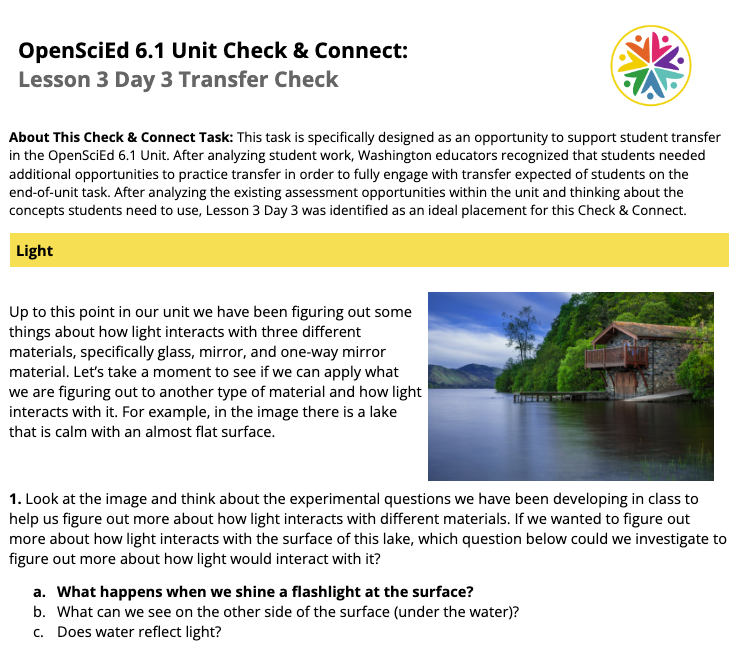
A short transfer task specifically designed for OpenSciEd Unit 6.1 in collaboration with Washington educators.
How Can Educators Use Contextus Resources?
Contextus resources are designed as open educational resources that are licensed as CC-BY-4.0. This license allows educators to use, modify, and reuse all of our resources to meet their needs. This license does require appropriate attribution, which means you must give credit to the author, provide a link to the license, and indicate if changes were made. You may do so in any reasonable manner, but not in any way that suggests that Contextus endorses you or your use. When the resources include content that licensed in a different manner, it will be noted on the final page of the resource.
This Toolkit is a sustained and supported professional learning experience designed to shift the culture of assessment to one that is more caring. The tools and processes presented here are the result of a pilot with educators from Colorado and Connecticut. The six modules are designed for flexible entry points and pathways to support district teams on a journey to develop more equitable 3D assessment systems with learners at the center.