


CONTEXTUS
Science Assessment in Context

Contextus represents the efforts of a community of educators, leaders, and partners dedicated to better science assessments that center learners.
We are teachers, administrators, state science leaders, researchers, and partners committed to creating the assessment system we need to for science teaching and learning to be meaningful, empowering, and rich for every learner.
Our resources, our community.
This is, first and foremost, a space of collaboration and community. All resources shared here represent ideas that someone thinks will be useful to others. We hope and expect that these resources will be adapted, leveraged for new ideas, and updated as we learn more about how to assess science learning. We hope that as you move through the process of assessing learning, you will in turn share the brilliance emerging in your contexts back with the Contextus community.

Featured Resources

A primary goal of science education is transfer. The ability to use prior learning to creatively solve new problems is especially important in the face of so-called “wicked problems” —complex issues such as climate change that will require interdisciplinary teams of innovative thinkers to resolve. Science education today must equip students to use their learning to tackle broad, intractable problems such as those laid out in the Millennium Project. However, achieving transfer is difficult for a number of reasons. Even once students are successfully instructed in ways that promote transfer, assessing that knowledge can prove difficult.


Deeply understanding what knowledge, skills, and abilities are actually needed to meet the vision of the Framework or standards like the Next Generation Science Standards requires spending time analyzing the standards.

The SAGE Project is the culmination of a multi-year project with multiple collaborators to establish and enact a vision for Science Assessment Grounded in Equity. While the tools and resources were designed using OpenSciEd as an instructional materials model, they can be adapted for other materials as well. We invite you to explore all of the resources: Getting Started, Designing Short Assessments & Adapted Tasks, Using Assessments to Improve Teaching & Learning, and Changing Systems
The criteria in this document distinguish between criteria for grades as a product and criteria for grading as a process. Grades are the result of the grading process and in order to have an equitable system, both the process of grading and the grades that are the result of that process must change.
This brief describes three ways that federal executive action can help states realize their visions for more meaningful assessments. To view the full report visit https://learningpolicyinstitute.org/ product/developing-assessment-systems-federal-support.

This is an example tasks that was specifically designed for use in teacher professional learning.

The beginnings of a practice brief and tool to support using student work in ways that build relationships.

This practice brief elevates the CCCs as a meaningful pathway to engage each and every student in science.

This AMSTI Bite-Sized Module, Equity, is the third of four Foundations of Three Dimensional Science Assessment modules.
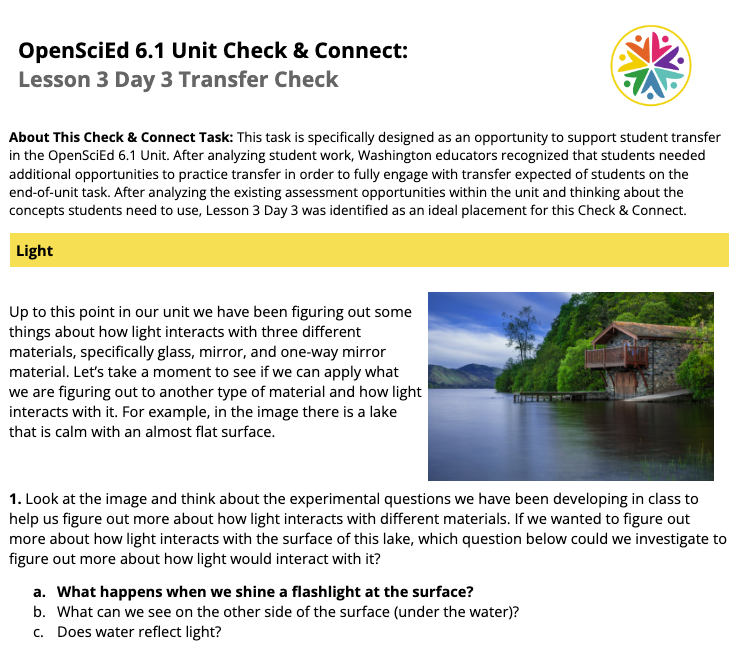
A short transfer task specifically designed for OpenSciEd Unit 6.1 in collaboration with Washington educators.


This AMSTI Bite-Sized Module, Introduction to Systems of Assessment, is the third of four Systematizing and Implementing Three Dimensional Science Assessments modules.

This AMSTI Bite-Sized Module, Student Work Analysis, is the first of four Systematizing and Implementing Three Dimensional Science Assessments modules.

This AMSTI Bite-Sized Module, Assessment Purpose and Use, is the last of four Foundations of Three Dimensional Science Assessment modules.
This Toolkit is a sustained and supported professional learning experience designed to shift the culture of assessment to one that is more caring. The tools and processes presented here are the result of a pilot with educators from Colorado and Connecticut. The six modules are designed for flexible entry points and pathways to support district teams on a journey to develop more equitable 3D assessment systems with learners at the center.